The management mandate for third-party owners, from scope to payment of proceeds
An agency that manages properties for owners other than itself holds a dated mandate, with its scope and management fees, reports to the owner each period and pays over what is due to them. A developer that has sold a property and follows it under warranty can also name its owner there.
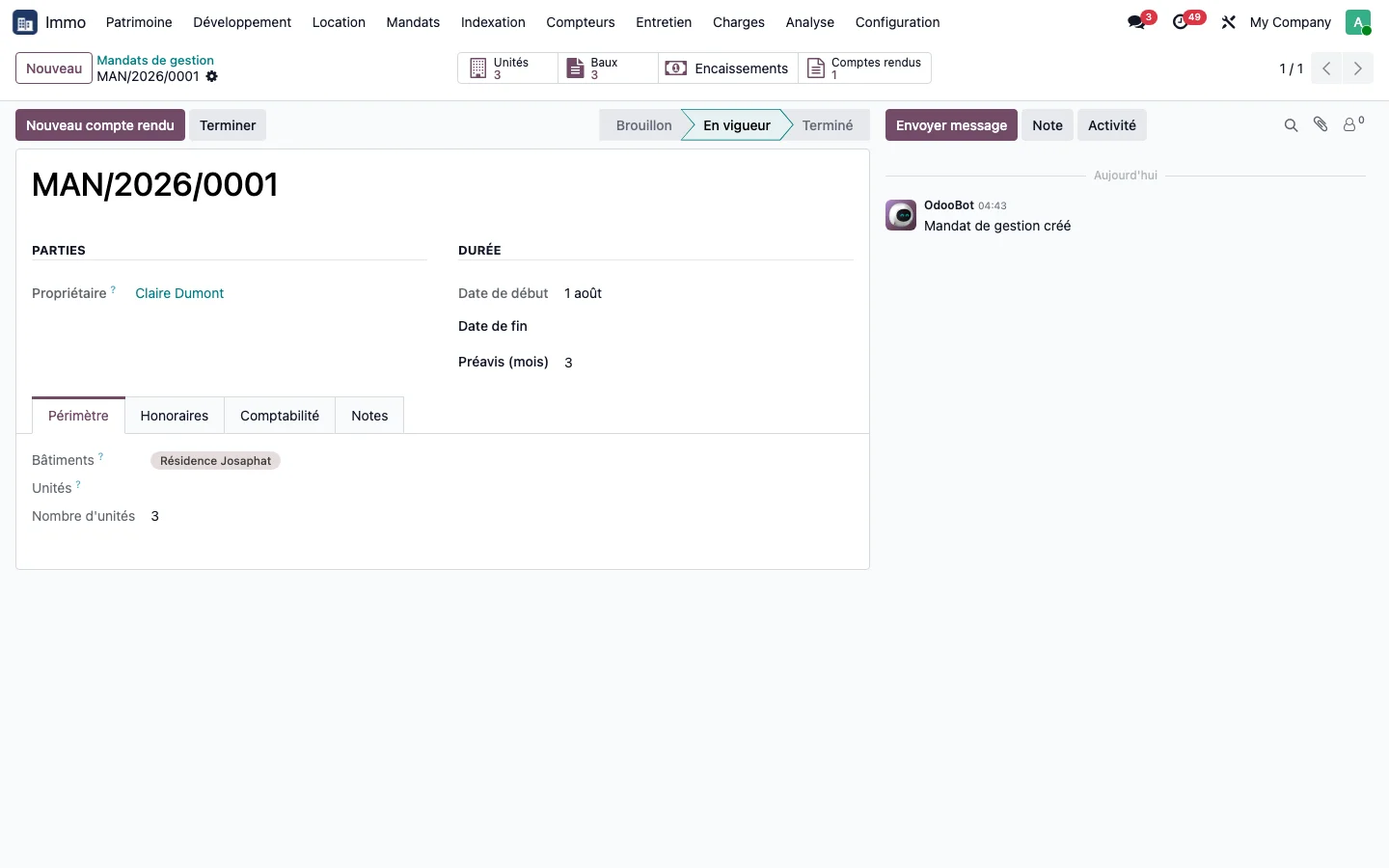
The owner carried by the property
The owner is named on the building or on the unit. The management mandate builds on it: the units covered, the start date, the notice period, the management fee rate, the frequency of the report, the third-party account and the owner's bank account. Rents are invoiced as usual, but those of units under mandate are booked to this third-party account, and not as agency income.
The report is calculated on the third-party account
At the end of the period, the management report reads this account: what has been collected, what remains due, what has been paid on behalf of the owner, and calculates the management fees. Unpaid rent is not paid over: it appears as arrears and will be picked up by the next report once paid.
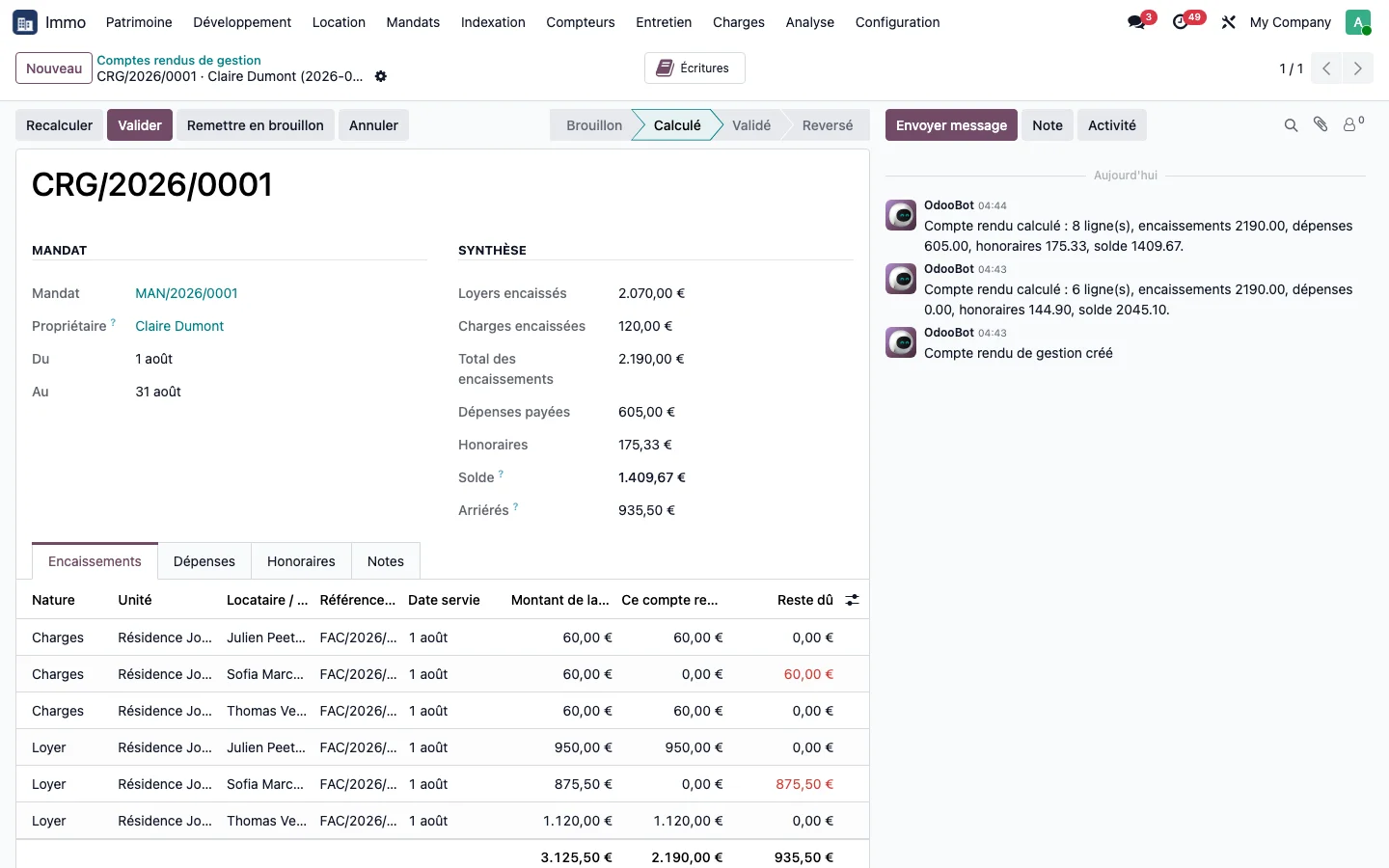
The figures as proof
On the demonstration database, the August report covers €2,070.00 of rent and €120.00 of service charge advances collected, €605.00 of expenses paid on behalf of the owner and €175.33 of management fees, i.e. 7% of the rent collected (€144.90 excluding VAT, €30.43 of VAT at 21%). The balance paid over to the owner is €1,409.67. After the payment, the third-party account carries only the arrears of the late tenant, i.e. €935.50.
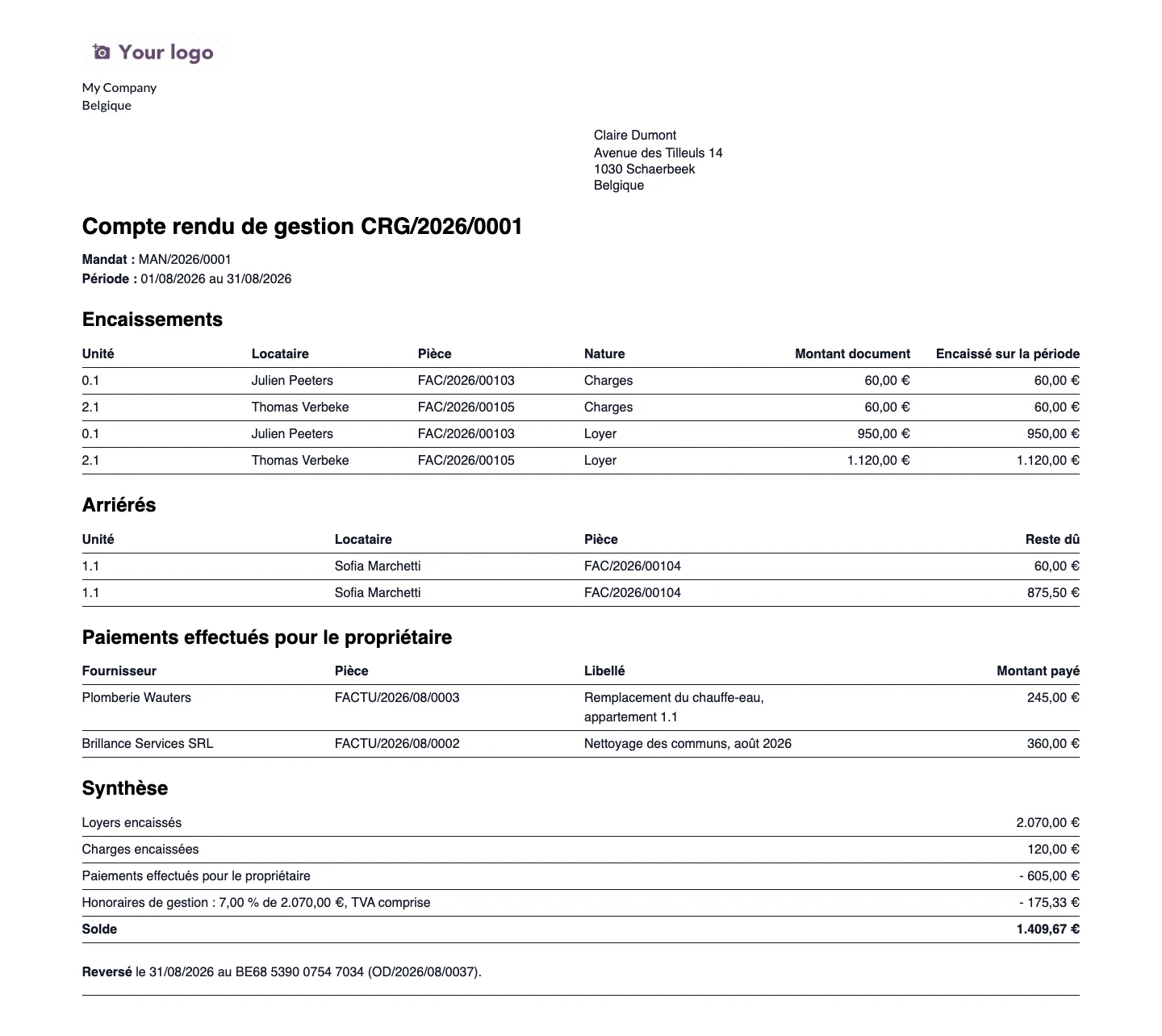
The document given to the owner
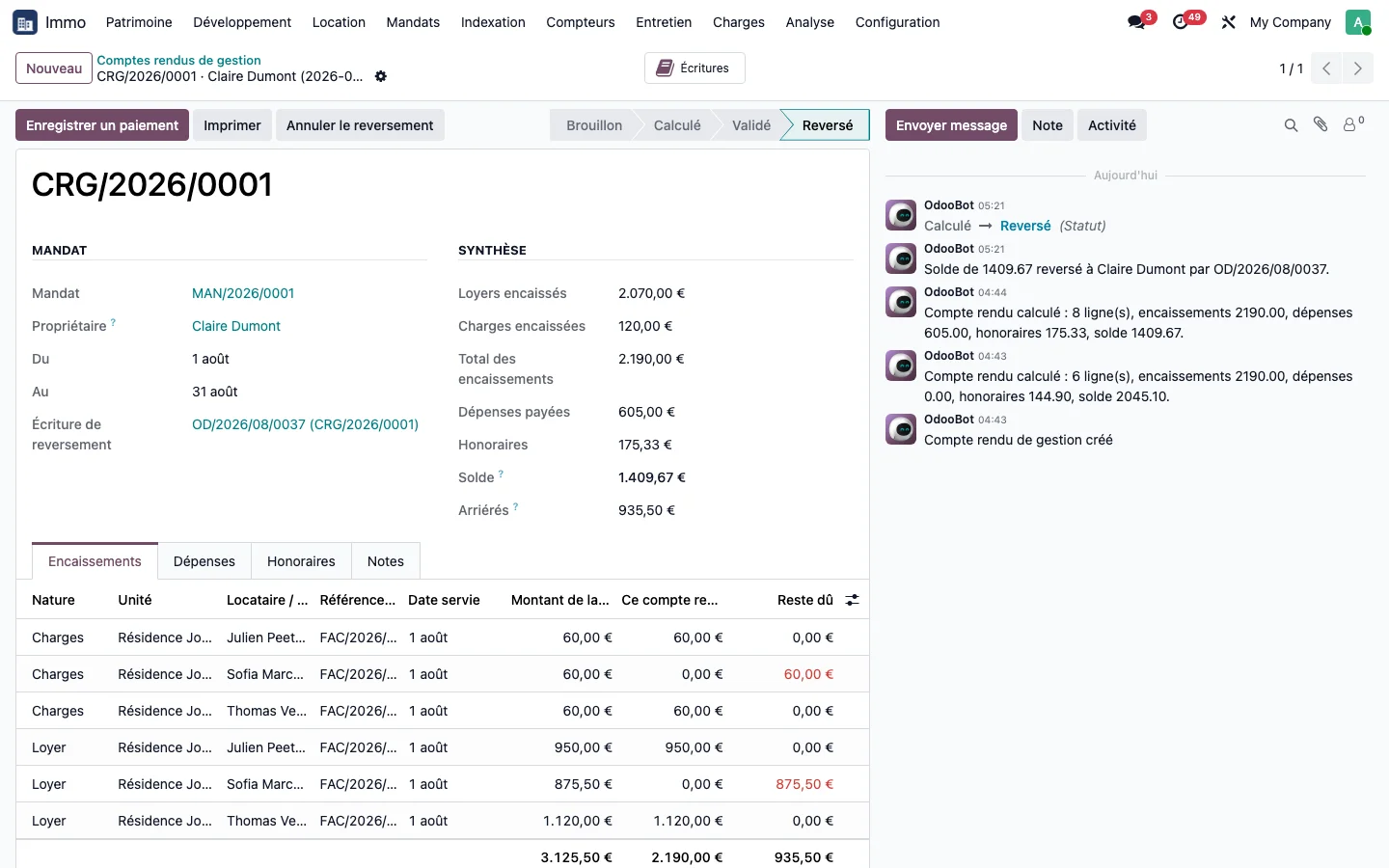
The approved report is paid over: the balance moves to the owner's vendor account and the standard payment settles it. The printed document given to them shows the receipts, arrears, expenses, management fees and balance, in their language.
Edge cases covered
- Unpaid rent is not paid over: it appears as arrears and will be picked up by the next report once paid.
- A report that has been paid over no longer changes: a correction goes into the next one, by credit note.
- Two mandates never cover the same unit on the same date.
- A mandate on a single flat in one of the agency's buildings takes only the rent: service charge advances and service charges stay with the agency.
- A loss written off on a rent does not count as a receipt.
What it replaces
The statement spreadsheet kept alongside the accounting, with rents ticked off by hand and management fees calculated separately, the transfer to the owner entered with no link to the rents it settles, and the fictitious mandate that had to be invented to name the owner of a property simply followed under warranty.
See TSC Immo on your own cases
A demonstration on a database with fictitious data, then on your own management questions.
 Connect. Transform. Grow.